
As welfare states face the pressures of demographic change, the sustainable organization of long-term care (LTC) has become a critical priority. Whether funded by taxes (like in the Nordic countries) or insurance (like in the Netherlands): every country is grappling with rising care needs and structural workforce shortages.
A recent comparative analysis by our Support4Resilience team, led by Felder et al. (2026), examined LTC systems across seven countries: Norway, Finland, the Netherlands, Romania, Spain, Italy, and Australia
In this blog post, we summarize the main points.
Strategies to Tackle Workforce Shortages in Elderly Care
Despite different LTC systems, we found that policymakers and healthcare managers across participating countries are adopting remarkably similar strategies to tackle workforce challenges:
- Aging in place: Encouraging older persons to continue living at home for as long as possible, reducing the strain on institutional facilities
- Informal support networks: Encouraging older persons to rely more on informal networks of support whilst trying to bridge the gap between formal services and informal caregivers.
- Service integration: Breaking down silos between acute care, home care, and social services to make the patient journey more efficient.
- Technological innovation: Leveraging innovations such as telemedicine, eHealth applications, and digital monitoring systems.
- Task shifting: Moving tasks to auxiliary workers or upskilling current staff.
The Role of Middle Managers in Healthcare Resilience
Our comparison first and foremost illustrates that countries try to tackle the workforce crisis from different angles, targeting both the demand and supply sides of the issue.Their successful implementation however also depends on the work of engaged and reflexive middle managers.
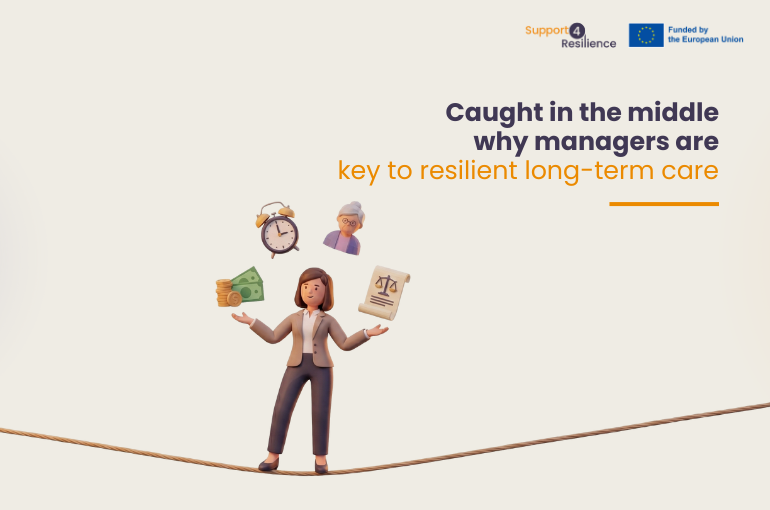
Positioned right in-between the shopfloor and higher management levels, middle managers must translate and mediate between regulatory frameworks, policy changes, organizational workforce strategies and the situated context in which everyday care is organized and provided; including individual patients’ and (informal) care workers’ needs and abilities. It is here that difficult trade-offs need to be made – for instance in terms of accessibility and quality – and about which organizational strategy to prioritize over others and when the best time is to do so.
In our study, we posit that middle managers therefore occupy a difficult yet crucial space when it comes to bolstering LTC resilience. We call this space the “multiple middle“. Yet, our research also shows that limited attention is paid to supporting middle managers in navigating this space. We expect them to implement complex workforce strategies and navigate value complexities, often without the necessary tools or organizational backing.
Interventions for Organizational Resilience and Well-being
Our study indicates a clear path forward: policymakers and researchers should prioritize the development of context-sensitive interventions that support middle managers in strengthening both organizational resilience and individual well-being.
This is particularly important because LTC resilience is not a static goal, but a relational and ongoing process of translating, learning, and adapting policy changes, workforce structures, care processes, and (in)formal care relationships and dependencies.
The Support4Resilience Toolbox
What’s Next? In the coming years, Support4Resilience aims to provide this support through a practice-oriented toolbox designed specifically for these managers.
By acknowledging the difficult position of the middle manager, we can help ensure that healthcare remains accessible, responsive, and of good quality, regardless of the system it operates within.
Dive Deeper
This blog post only scratches the surface of our comparative analysis across seven countries. To explore the data in depth:
Written by: Martijn Felder, from Erasmus University Rotterdam