
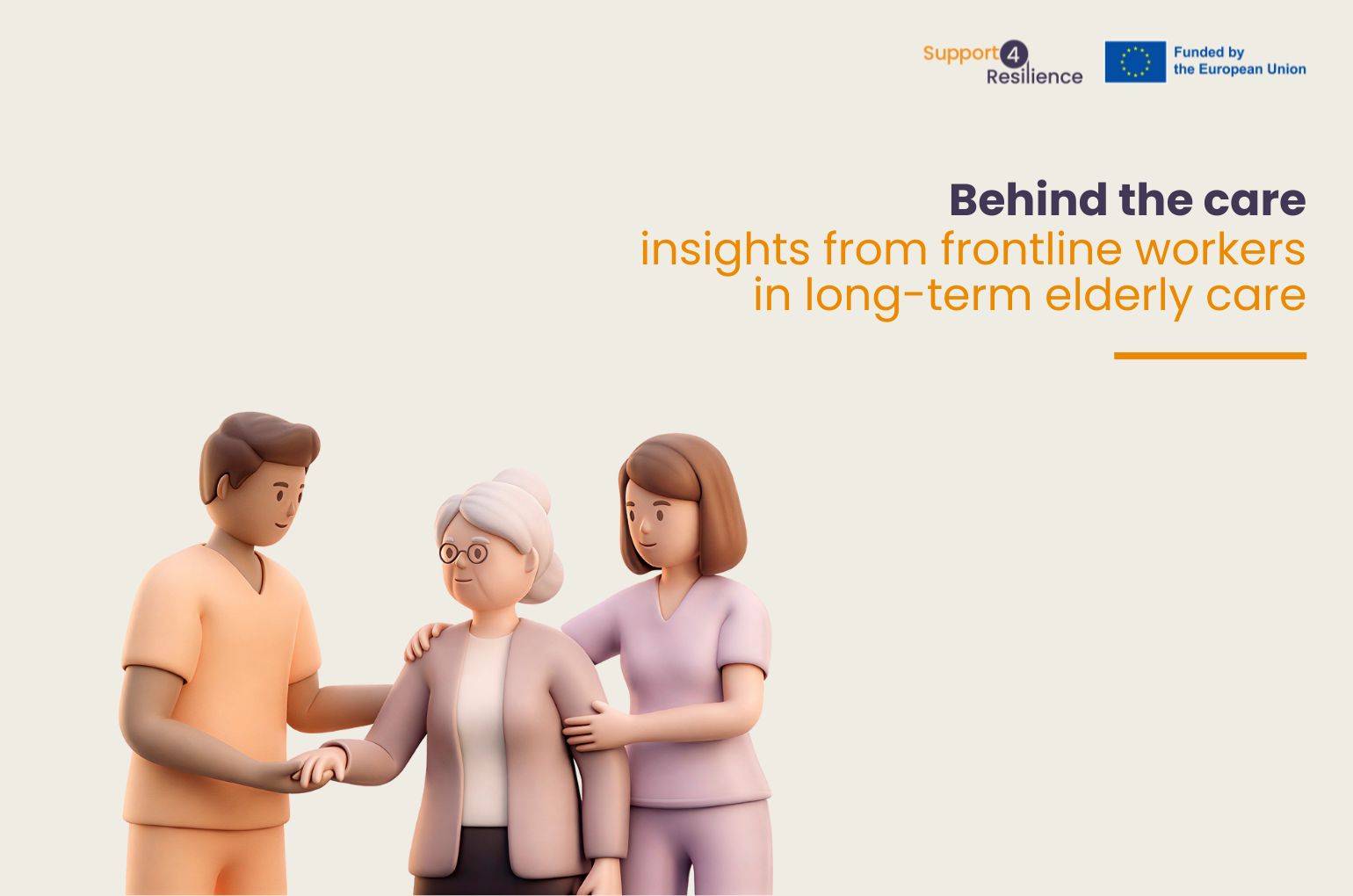
As demographic aging accelerates across Europe, the sustainability and quality of long-term care systems have become pressing concerns for health and social policy (European Commission, 2018). While much of the discourse remains focused on care recipients — particularly the frail elderly affected by chronic, degenerative, or cognitive conditions — far less attention is devoted to those who provide care on a daily basis: the healthcare workers operating inside long-term residential facilities (Vartiainen et al., 2025).
A recent qualitative inquiry, based on a series of focus groups with professionals from three Italian residential care facilities operated by Fondazione Casa Cardinale Maffi ONLUS, offers an insight into the other side of care.
Understanding “work as done” in elderly care
For the healthcare workers in this sector, their work significantly exceeds the formal boundaries of the job descriptions: their roles are inherently interdisciplinary, dynamic, and highly relational. Tasks span from morning hygiene routines to medication distribution, from administrative support to emotional care for patients and their families. Particularly notable is the perception of an implicit transfer of responsibility in the absence of physicians, especially in complex or urgent care situations.
Collaboration emerges as a core theme, not only within professional teams (e.g., nurses, physiotherapists, occupational therapists) but also in relation to patients and their families. The concept of “taking care of the person” — rather than merely performing tasks — is central to participants’ narratives, underscoring an ethics of empathy and human presence that defines the caregiving identity.
Resilience as a collective phenomenon
Resilience, often conceptualized as an individual attribute, is framed by participants as a collective accomplishment. Workers describe mutual support practices, shared problem-solving during staff shortages, and a continuous effort to adapt care to patient needs despite time and resource constraints. Monthly briefings, peer consultations, and digital patient record systems are the key tools enabling the coordination and the responsiveness.
Participants also link the quality of care to team cohesion, shared values, and the intrinsic motivation to ensure dignity and well-being for residents — often at a personal cost. Several reported working double shifts, covering for colleagues, or “sacrificing” personal time in the name of service continuity.
Emotional labor and mental wellbeing
The psychological burden of care work emerges as a recurrent theme. Exposure to end-of-life situations, combined with physical exhaustion and high emotional demands, significantly impacted workers’ mental health. The pressure exerted by families’ expectations, the constant race against time, and the cumulative nature of stress are widely reported.
Nevertheless, positive mental wellbeing is associated with three main protective factors: a supportive team environment, feeling heard by leadership, and the availability of digital tools that facilitated organizational efficiency. Participants also highlighted the absence of structured psychological support as a key gap in their work environment.
Safety, risk, and crisis management
While serious adverse events are perceived as infrequent, participants acknowledge specific risks such as patient falls and interpersonal tensions during shared activities (e.g., meals). Safety is framed as a product of vigilance, environmental control, and team-based monitoring. Crisis preparedness is mainly addressed through standardized protocols, monthly audits, and regular training on topics including infection control, fire safety, and hazard analysis.
Participants emphasize the importance of briefings and interdisciplinary dialogue in both preventing and responding to adverse events, reinforcing the centrality of collective responsibility in ensuring patient safety.
Leadership, training, and professional development
Leadership support is described as uneven. On one hand, participants appreciate the availability of training programs — including opportunities to enroll in advanced courses and specialization programs (e.g., pressure ulcer management). On the other, many perceive decision-making processes as top-down and unresponsive. Several report that issues raised in meetings often go unresolved, fostering frustration and a sense of disconnect between frontline realities and managerial priorities.
Importantly, some staff reports having the opportunity to propose training topics based on observed needs (e.g., dysphagia), suggesting potential for co-produced capacity-building when organizational channels are responsive.
What workers ask for: structural and relational solutions
The solutions proposed by participants are pragmatic and deeply grounded in daily experience. They include:
- The creation of dedicated break spaces.
- Improved staffing levels.
- More flexible shift structures.
- Structured psychological support.
Above all, workers call for increased inclusion in decision-making processes, clearer recognition of their expertise, and stronger collaboration between leadership and care teams.
Conclusion: re-centering the workforce in elderly care policy
This qualitative exploration offers rich, practice-based insights into the challenges and resources of long-term care workers. It points to the need for care systems to go beyond instrumental or technical understandings of healthcare work, acknowledging the relational, emotional, and ethical dimensions of care.
Improving care for the elderly cannot be achieved solely through infrastructure or medical innovation. It requires supporting — structurally, psychologically, and professionally — those who care. Their voices offer not just testimony, but direction.
Writtten by: Luca Scopis, from Scuola Superiore Sant’Anna.
References
European Commission. (2018). Challenges in long-term care in Europe: A study of national policies. Publications Office. https://data.europa.eu/doi/10.2767/84573
Vartiainen, A.-K., Lungu, D. A., Rissanen, E., Pirrotta, L., Scopis, L., Schroeder, T., Sogstad, M., Odberg, K. R., Hole, A., Delgado-Saborit, J. M., Lahti, M., Haraldseid-Driftland, C., Belle, N., Ellis, L., Wiig, S., & Kankaanpää, E. (2025). The effectiveness and economic evidence of organizational and management interventions to promote mental wellbeing and resilience in elderly care workers and informal caregivers – a systematic review. BMC Health Services Research, 25(1), 1345. https://doi.org/10.1186/s12913-025-13372-7