
Why are younger healthcare professionals reporting burnout and lower job satisfaction? Evidence points to a mix of workload, career expectations, organisational support, mentoring and changing attitudes towards work. This article explores what makes healthcare careers less attractive to some young people and what leaders can do to support Gen Z professionals.
Careers in healthcare often attract individuals with altruistic traits, such as compassion and a strong desire to care for others. The recruitment of future professionals with high moral standards and strong ethical character is essential across all sectors of healthcare, as these qualities are known to directly impact both quality of care and patient outcomes. Despite the inherently noble nature of healthcare professions, there has been a noticeable decline in the number of applicants to healthcare degree programs across European countries in recent years. This trend suggests that careers such as nursing, healthcare assistance, and social work are becoming less attractive to young people and adolescents. Notably, the field of medicine—particularly the ambition of becoming a medical doctor—appears to be an exception to this pattern.
Why are fewer young people choosing healthcare careers?
Nursing continues to be perceived as a stressful and financially undervalued job, and the post-COVID-19 pandemic situation seems to have heightened this perspective. A recent OECD policy brief pointed out that notable changes have been noted, across countries, in students’ interest in embarking on a nursing career between right before the pandemic and its end in 2022. Interestingly, this shift does not seem to be related with the severity of the pandemic as shown either in terms of reported COVID-19 death rates or reported COVID-19 infection rates. What may contribute to this trend is yet to be studied, but what may be worrying is that this declining interest only adds to the existing problems in healthcare systems, mainly the high rates of burnout and quitting.
Why is Gen Z burnout in healthcare different?
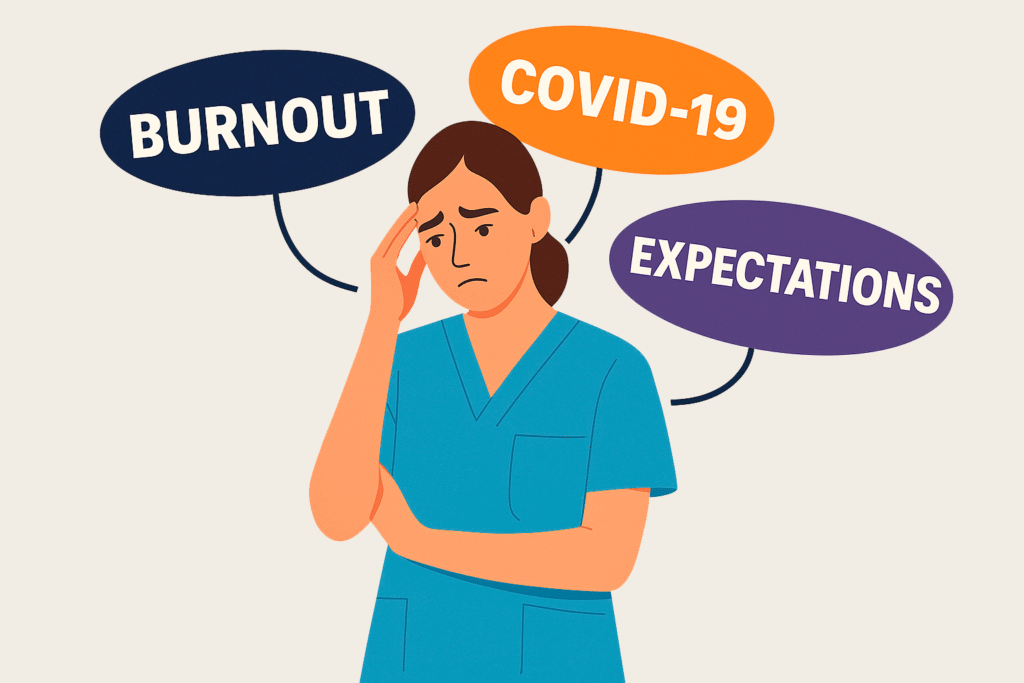
Research suggests that young (i.e., 18–35 year-olds) nurses’ sources of burnout may be different from what older nurses report. While older nurses seem to have viewed the pandemic as one of the key sources of burnout, younger nurses may perceive as their sources of stress issues that are rather long-standing (e.g., personality-related vulnerabilities) than transient (e.g., COVID-19 pandemic). Related to this, a new study published by the Nuffield Trust indicates that there is a widening gap between the levels of satisfaction reported by youngest versus the oldest staff in UK’s National Health System, which may be understood by some as a ‘ticking bomb’.
Expectations vs Reality
The fact that nowadays many young nurses across healthcare services declare that they often feel miserable and helpless at work may be indicative of multiple-level factors (i.e., individual, organizational and contextual) operating together yet poorly understood. It may be that the younger generation (not only in healthcare, but across professions) often start their careers with mismatched expectations in relation to what the actual job entails. It may also be that managers do not know how to provide them with the most suitable training opportunities that would offer an optimal transition from the education to the professional environment. Regardless of all this, it is still difficult to anticipate how young workers will manage to cope in the long run within structures that are proved to elicit overwhelming amounts of negative emotions and few opportunities for self-taught regulation strategies (something that young people may look out for by default using online resources primarily). This is surely something to watch out for by their clinical supervisors and healthcare leaders.
Tech-savvy workforce
On the other hand, rapid technological advancements in biosciences and healthcare means that the youngest staff have the greatest potential to quickly integrate and become competent and versatile in using the newest technologies in a field that has traditionally and almost exclusively relied on human-to-human contact. Whether this progress will alter the nature of the relationship between healthcare staff and their patients and, if yes, in what way remains to be studied. Anyway, new and unprecedented challenges are likely to emerge with the integration of new technology and, possibly most importantly, artificial intelligence in healthcare routines.
How leadership and mentorship can support Gen Z healthcare workers
One of the key strategies healthcare systems can focus on is how leaders prepare and support young professionals as they navigate these changes. Leaders may need to reflect on their own roles and capabilities and strengthen how they provide meaningful interaction, mentoring and guidance to their youngest colleagues in increasingly technology-rich environments.
This connects directly with the wider evidence on leadership and resilience in elderly care, where psychological safety, workload and professional support are also central.
Related reading: see how managers can strengthen resilient long-term care and how organisational conditions influence mental health and burnout in elderly care.
Written by: Florin Tibu, from Universitatea Stefan Cel Mare Din Suceava
References
Rubbi, I., Lupo, R., Lezzi, A., Cremonini, V., Carvello, M., Caricato, M., Conte, L., Antonazzo, M., Caldararo, C., Botti, S., Andretta, V., Lattarulo, P., & Vitale, E. (2023). The Social and Professional Image of the Nurse: Results of an Online Snowball Sampling Survey among the General Population in the Post-Pandemic Period. Nursing Reports, 13(3), https://doi.org/10.3390/nursrep13030109 1291–1303.
OECD (2024). Fewer young people want to become nurses in half of OECD countries. https://www.oecd.org/en/publications/fewer-youngpeople-want-to-become-nurses-in-half-of-oecdcountries_e6612040-en.html
O’Hara C, Reid M. The under 35 nursing workforce in 2022: overworked, under supported, and burned out. J Nurs Regul. 2024;15(1):45–55. https://doi.org/10.1016/S2155-8256(24)00028-0
Nuffield Trust. New study shows widening gulf in job satisfaction between the NHS’s youngest and oldest staff. 20 Feb 2025. https://www.nuffieldtrust.org.uk/news-item/new-study-showswidening-gulf-in-job-satisfaction-between-the-nhs-s-youngest-and-oldest-staff